
Blog
The Duality of the Fruit Fly: Kitchen Nuisance to Scientific Kingpin

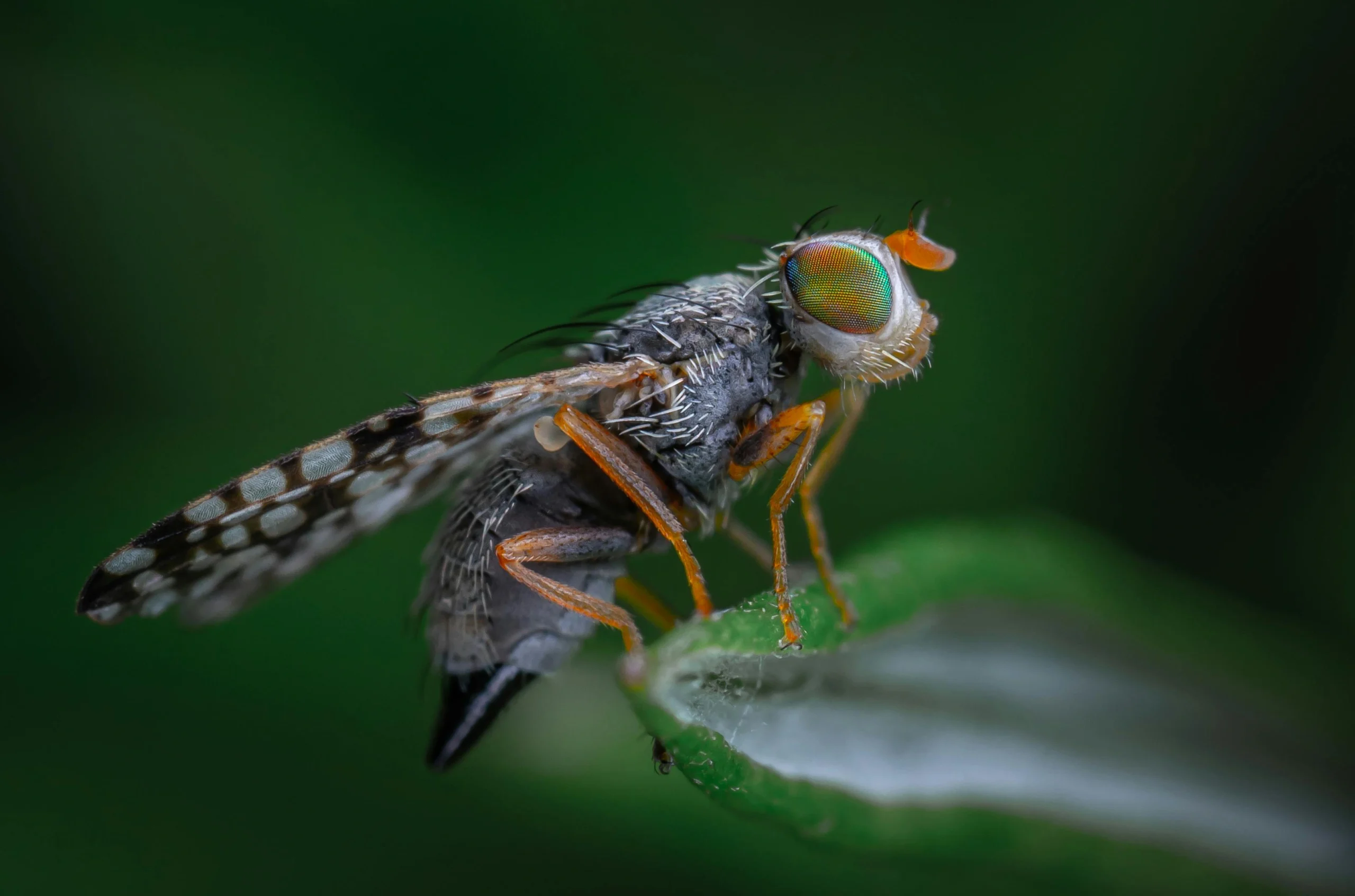
Unpacking the Identity Crisis: Pest vs. Professor
For most people, the term “fruit fly” brings to mind a buzzing nuisance circling a ripening banana in the kitchen. In reality, this common image represents just one type of fly, whose importance varies wildly from its larger, more destructive cousins.
The scientific community recognizes two primary groups:
- The Vinegar or Ferment Flies (Drosophilidae): Such as Drosophila melanogaster.
- The True Fruit Flies (Tephritidae): Such as the Mediterranean fruit fly (Medfly).
D. melanogaster is the small, frequent household visitor (typically 1 to 3 mm long) that deposits eggs on rotting flesh and feeds in fermenting, overripe fruit. Conversely, the “true” fruit flies, like the Medfly, are larger (4 to 6 mm) and attack healthy fruit well before it rots, posing an extraordinary threat to agriculture. Originating from tropical Africa, the Medfly infests over 200 fruit and vegetable species globally.
Mastering the Household Nuisance (Drosophila)
If you are dealing with a swarm of small, brown flies indoors, you are most likely fighting Drosophila melanogaster, the common vinegar fly. While these fruit fly infestations are frustrating, simple household hacks can lead to rapid elimination.
The Expert Trap: Vinegar, Soap, and Surface Tension
The most effective homemade traps use attractants to lure the flies into a container. Liquids that attract these flies include:
- Apple cider vinegar
- Red wine
- Sugar or molasses
- Beer or fruit juices
The critical difference between a successful trap and a failure is a simple additive: dish detergent or soap. Adding just a few drops of dish soap breaks the surface tension. This makes it impossible for the fruit fly to land on the liquid and fly away, causing them to drown. For maximum effectiveness, cover the container with plastic wrap and poke small holes in it.
Finding Hidden Breeding Sites
If traps catch flies but the population persists, the source may be a hidden breeding ground. Drosophila prefer warm, damp spaces.
- Kitchen Sink Drains: Flies frequently breed in gunk-filled drains.
- Refrigerator Pans: Check the evaporative pan underneath the refrigerator.
- Misidentified Pests: If they resist traps and boiling water, they may be Drain Flies (Psychodidae), not fruit flies. These require enzyme cleaners to remove pipe gunk.
Protecting Your Harvest (Tephritidae Control)
Controlling agricultural pests like the Medfly requires an integrated strategy focusing on hygiene and critical timing.
Cultural Control: Hygiene and Timing
When to Start Control:
Medfly control must begin in the spring when overwintering adults emerge. If control is not started early (when temperatures exceed 12°C), populations will increase causing significant damage.
Proper Fruit Disposal:
Infested fruit must be destroyed. Merely throwing it away risks spreading the pest. Recommended disposal methods include:
- Soaking fruit in water topped with kerosene for 4–5 days to cut off oxygen.
- Freezing, cooking, or pureeing the fruit.
- Note: Do not bury infested fruit, as larvae can survive.
Chemical Control: Baiting vs. Spraying
Two main chemical methods are recommended for backyard fruit fly control:
- Foliage Baiting (Targeting Adults): Combines an insecticide with a protein source (like yeast or sugar) to attract female flies needing protein for eggs. You only need to spray a patch of the foliage.
- Cover Spraying (Life Cycle Control): Involves covering the fruit and foliage with insecticide to kill all stages from egg to adult.
[Image Recommendation: A person applying bait spray to a fruit tree. Alt Text: Gardener applying fruit fly bait to citrus tree foliage.]
The Scientific Kingpin (Drosophila melanogaster)
Despite its role as a pest, the Drosophila melanogaster fruit fly is arguably the most well-known organism in science. It has been the subject of curiosity for nearly a century.
The Nobel Legacy: Genetics and Mutations
Fruit fly research has led to six Nobel Prizes in Physiology or Medicine:
- Heredity (1933): Thomas Hunt Morgan used “The Fly Room” to prove genes are arranged on chromosomes.
- Mutations (1946): Hermann Joseph Muller proved X-rays trigger genetic mutations.
- Embryonic Development (1995): Researchers identified genes controlling early embryonic development.
Modeling Human Disease
The fly is indispensable because of the evolutionary conservation of basic biological processes. The fruit fly genome shows clear relationships to roughly 65% of genes associated with human diseases. This allows scientists to study everything from cancer and wound healing to learning and aging.
High-Tech Control: The Sterile Insect Technique (SIT)
The Sterile Insect Technique (SIT) is a specialized area-wide control method for Tephritid fruit flies.
This technique involves mass-rearing the pest, sterilizing the pupae (usually via irradiation), and releasing millions of sterile adults. These sterile males compete with wild males. Because they cannot produce viable offspring, the wild population eventually collapses. SIT is an eco-friendly tool perfect for sensitive suburban areas.
Conclusion: Beyond the Annoyance
The humble fruit fly, whether the tiny ferment fly or the damaging Medfly, plays an outsized role in our world. From enabling foundational genetic discoveries to driving modern cancer research, the fly is a creature of duality. Whether you admire it for its scientific contributions or set traps to protect your kitchen, managing this species requires biological understanding.